What can I do?

226539 materialEducativo

textoFiltroFicha
  • I like 0
  • Visits 9
  • Comments 0
  • Save to
  • Actions

About this resource...

Análisis funcional
DbpediaThing
Wikipedia articleDbpedia source
Functional analysis is a branch of mathematical analysis, the core of which is formed by the study of vector spaces endowed with some kind of limit-related structure (e.g. inner product, norm, topology, etc.) and the linear operators acting upon these spaces and respecting these structures in a suitable sense. The historical roots of functional analysis lie in the study of spaces of functions and the formulation of properties of transformations of functions such as the Fourier transform as transformations defining continuous, unitary etc. operators between function spaces. This point of view turned out to be particularly useful for the study of differential and integral equations.The usage of the word functional goes back to the calculus of variations, implying a function whose argument is a function and the name was first used in Hadamard's 1910 book on that subject. However, the general concept of functional had previously been introduced in 1887 by the Italian mathematician and physicist Vito Volterra. The theory of nonlinear functionals was continued by students of Hadamard, in particular Fréchet and Lévy. Hadamard also founded the modern school of linear functional analysis further developed by Riesz and the group of Polish mathematicians around Stefan Banach.In modern introductory texts to functional analysis, the subject is seen as the study of vector spaces endowed with a topology, in particular infinite dimensional spaces. In contrast, linear algebra deals mostly with finite dimensional spaces, and does not use topology. An important part of functional analysis is the extension of the theory of measure, integration, and probability to infinite dimensional spaces, also known as infinite dimensional analysis.
Análisis funcional

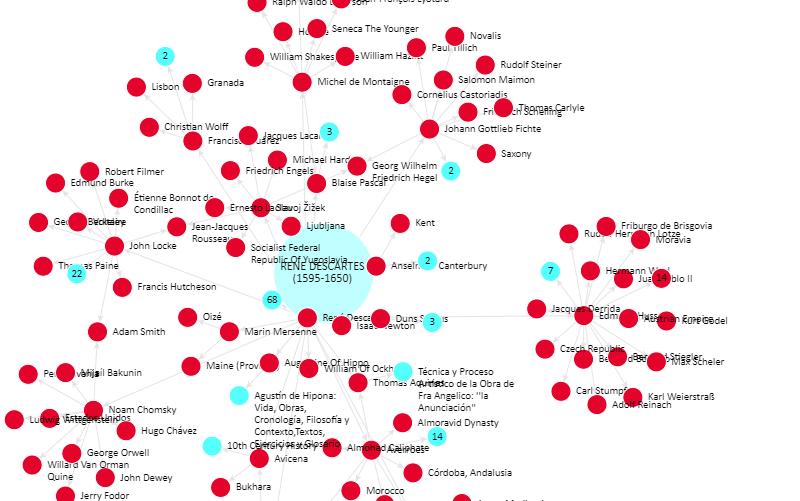
Conceptual map: Análisis funcional

Exclusive content for members of

D/i/d/a/c/t/a/l/i/a
Sign in

Mira un ejemplo de lo que te pierdes

Categories:

Fecha publicación: 28.4.2015

Comment

0

Do you want to comment? Sign up or Sign in

Join Didactalia

Browse among 226539 resources and 574237 people

Regístrate >

O conéctate a través de:

Si ya eres usuario, Inicia sesión

Do you want to access more educational content?

Sign in Join a class
x

Add to Didactalia Arrastra el botón a la barra de marcadores del navegador y comparte tus contenidos preferidos. Más info...


Game help
Juegos de anatomía
Selecciona nivel educativo