What can I do?

Lessons from Didactalia

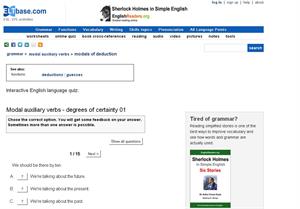
Verbos Modales: Modals (can, could, might, must, should, will, would)

Cancel SAVE
  • I like 0
  • Visits 6659
  • Comments 0
  • Save to
  • Actions

tipo de documento Lessons

Curriculum information

Level: 14-15 años Subject: Lengua Extranjera - Inglés
Cancel SAVE

Introduction to the lesson

This lesson will expand knowledge of the following contents:

English modal verbs

The modal verbs of English are a small class of auxiliary verbs used mostly to express modality (properties such as possibility, obligation, etc.). They can be distinguished from other verbs by their defectiveness (they do not have participle or infinitive forms) and by their neutralization (that they do not take the ending -(e)s in the third-person singular).

References

Terminology:

Protagonists:

Credits: the previous information has been extracted from the following Wikipedia articles

Introduction to the lesson

This lesson will expand knowledge of the following contents:

English modal verbs

The modal verbs of English are a small class of auxiliary verbs used mostly to express modality (properties such as possibility, obligation, etc.). They can be distinguished from other verbs by their defectiveness (they do not have participle or infinitive forms) and by their neutralization (that they do not take the ending -(e)s in the third-person singular).

References

Terminology:

Protagonists:

Credits: the previous information has been extracted from the following Wikipedia articles

Didactic units

Verbos Modales - Modals (aprenderinglesfacil)

Verbos modales: Used to

"To be used to" & " To get used to"

Conceptual map: Verbos Modales: Modals (can, could, might, must, should, will, would)

Exclusive content for members of

D/i/d/a/c/t/a/l/i/a
Sign in

Mira un ejemplo de lo que te pierdes

Comment

0

Do you want to comment? Sign up or Sign in

Join Didactalia

Browse among 226539 resources and 574237 people

Regístrate >

O conéctate a través de:

Si ya eres usuario, Inicia sesión

Temas de: inglés - 3º eso

Adjetivos Posesivos

Nivel educativo: 14-16 años/3º-4º ESO

Document class

Pasado Participio de los verbos regulares e irregulares

Nivel educativo: 14-16 años/3º-4º ESO

Document class

Verbos Irregulares

Nivel educativo: 14-16 años/3º-4º ESO

Document class

Artículos determinados e indeterminados

Nivel educativo: 14-16 años/3º-4º ESO

Document class

Grados del Adjetivo: Positivo, Comparativo y Superlativo

Nivel educativo: 14-16 años/3º-4º ESO

Document class

Verbos regulares

Nivel educativo: 14-16 años/3º-4º ESO

Document class

Preposiciones de tiempo: for, since, how long, at, in, on

Nivel educativo: 14-16 años/3º-4º ESO

Document class

Futuro Simple: Simple Future

Nivel educativo: 14-16 años/3º-4º ESO

Document class

Verbos Modales: Modals (can, could, might, must, should, will, would)

Nivel educativo: 14-16 años/3º-4º ESO

Document class

Lengua y Sociedad: Aspectos socioculturales de la lengua inglesa

Nivel educativo: 14-16 años/3º-4º ESO

Document class

Expresiones de cantidad: Much - Many / Little- Few / A lot of - Plenty

Nivel educativo: 14-16 años/3º-4º ESO

Document class

Vocabulary: clothes, jobs, feelings

Nivel educativo: 14-16 años/3º-4º ESO

Document class

Do you want to access more educational content?

Sign in Join a class
x

Add to Didactalia Arrastra el botón a la barra de marcadores del navegador y comparte tus contenidos preferidos. Más info...


Game help
Juegos de anatomía
Selecciona nivel educativo