
Cargando...

What can I do?
226539 materialEducativo
textoFiltroFichatipo de documento Technology - Experiment/Lab
About this resource...
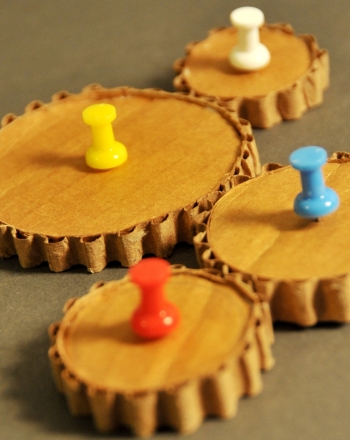
Gears are the toothed wheels used in many machines, including bicycles, where they work together to change the relationship between the driving mechanism and the moving parts. You pedal the cranks to turn the chainring, which is connected by a chain to smaller gears that move the rear wheel. You change gears depending on terrain. If you are riding up a steep hill, you might want to shift into a lower (larger) gear. This makes it easier to turn the cranks, but the rear wheel doesn’t turn as much with each rotation of the cranks. When you get to a level or downhill stretch of road, you probably switch to a higher gear, where each turn of the cranks leads to more turns of the rear wheel.Your muscles might know all about bike gears, but your mind might need an opportunity to play around with them to really understand how they work. In this activity, you will learn how to make gears from scratch. Then, you can move them around. Let’s learn some math before we get started.The radius of a circle is the distance from its center to its edge. Diameter is twice the radius—it’s the straight line distance across the center of a circle. Circumference is the distance around a circle. Thousands of years ago, Greek mathematicians discovered the ratio of a circle’s circumference to its diameter and called it π (pi), which is approximately equal to 3.14159. The circumference of a circle can be found using the following equation: πd=C. This equation will come in handy when cutting out your cardboard gear teeth.
It is an educational content by education.com.
By clicking on the title of this resource, you will be redirected to the content. If you want to download the project, you just have to join the website, which now is for FREE.
Mira un ejemplo de lo que te pierdes
Autores:
Categories:
Fecha publicación: 12.5.2016
The original license is kept.
Add to Didactalia Arrastra el botón a la barra de marcadores del navegador y comparte tus contenidos preferidos. Más info...







Comment
0