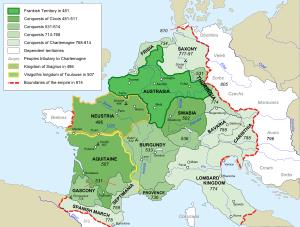
The Saxon Wars were the campaigns and insurrections of the more than thirty years from 772, when Charlemagne first entered Saxony with the intent to conquer, to 804, when the last rebellion of disaffected tribesmen was crushed. In all, eighteen battles were fought in what is now northwestern Germany. They resulted in the incorporation of Saxony into the Frankish realm and their forcible conversion from Germanic paganism to Catholicism. Despite repeated setbacks, the Saxons resisted steadfastly, returning to raid Charlemagne's domains as soon as he turned his attention elsewhere. Their main leader, Widukind, was a resilient and resourceful opponent and accepted a peace offering from Charlemagne in a perilous situation, not losing his face and preventing Charlemagne from continuing a bothersome war. This agreement saved the Saxons' leaders' exceptional rights in their homeland.Widukind (ahd Waldkind, "Child of forest") was baptized in 785 and buried in the only Germanic church without a spire. The Saxons were divided into four subgroups in four regions. Nearest to the ancient Frankish kingdom of Austrasia was Westphalia, and farthest away was Eastphalia. In between these two kingdoms was that of Engria (or Engern) and north of these three, at the base of the Jutland peninsula, was Nordalbingia.
Combatant
Saxons
Carolingian Empire
Commander
http://didactalia.net/items/BritishRoyalty_729ebebc-84d6-4cd8-bfb2-c228e7d87314_7ae45c15-7e0b-4fb0-b580-0c056aab4a95
http://didactalia.net/items/Noble_cc9ac751-7efc-4422-aa77-65ca023ce369_db2cafde-b59e-4403-83c0-0306bd1b2bc6
Result
Conversion of the Saxons to Christianity
Frankish Empire annex Saxon land











Comment
0