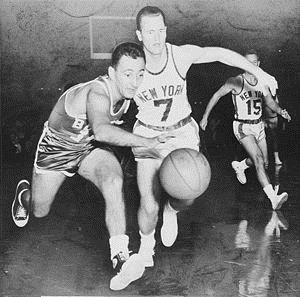
The point guard (PG), also called the one or point, is one of the five positions in a regulation basketball game. A point guard has perhaps the most specialized role of any position. They are expected to run the team's offense by controlling the ball and making sure that it gets to the right players at the right time. Above all, the point guard must totally understand and accept their coach's game plan; in this way, the position can be compared to a quarterback in American football or a playmaker in association football (soccer). A point guard, like other player positions in basketball, specializes in certain skills. A point guard's primary job is to facilitate scoring opportunities for his/her team, or sometimes for themselves. Lee Rose has described a point guard as a coach on the floor, who can handle and distribute the ball to teammates. This involves setting up plays on the court, getting the ball to the teammate in the best position to score, and controlling the tempo of the game. A point guard should know when and how to instigate a fast break and when and how to initiate the more deliberate sets. Point guards are expected to be vocal floor leaders. A point guard needs always to have in mind the times on the shot clock and the game clock, the score, the numbers of remaining timeouts for both teams, etc. Among the taller players who have enjoyed success at the position is Magic Johnson, who was 6' 9" (2.06 m) and won the National Basketball Association Most Valuable Player Award three times in his career. Other point guards who have been named NBA MVP include Derrick Rose, Bob Cousy, Oscar Robertson (who somewhat foreshadowed Johnson in that he was 6' 5" (1.96 m), the height of many forwards in his era), and two-time winners Stephen Curry and Steve Nash. In the NBA, point guards are usually about 6' 5" (1.96 m) or shorter, and average about 6' 2.75" (1.90 m). Having above-average size (height, muscle) is considered advantageous, although size is secondary to situational awareness, speed, quickness, and ball handling skills. Shorter players tend to be better dribblers since they are closer to the floor, and thus have better control of the ball while dribbling. After an opponent scores, it is typically the point guard who brings the ball down court to begin an offensive play. Passing skills, ball handling, and court vision are crucial. Speed is important; a speedy point guard is better able to create separation and space off the dribble, giving him/herself room to work. Point guards are often valued more for their assist totals than for their scoring. Another major evaluation factor is Assist-to-Turnover ratio, which reflects the decision-making skills of the player. Still, a first-rate point guard should also have a reasonably effective jump shot.







Comment
0