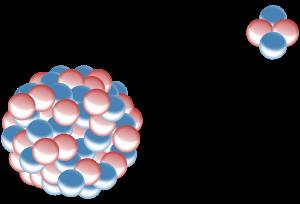
Alpha decay, or α-decay, is a type of radioactive decay in which an atomic nucleus emits an alpha particle and thereby transforms (or 'decays') into an atom with a mass number 4 less and atomic number 2 less. For example, uranium-238 decaying through α-particle emission to form thorium-234 can be expressed as:Because an alpha particle is the same as the nucleus of a helium-4 atom - consisting of two protons and two neutrons and thus having mass number 4 and atomic number 2 - this can also be written as:Notice how, on either side of the nuclear equation, both the mass number and the atomic number are conserved: the mass number is 238 on the left side and (234 + 4) on the right side, and the atomic number is 92 on the left side and (90 + 2) on the right side.The alpha particle also has a charge +2, but the charge is usually not written in nuclear equations, which describe nuclear reactions without considering the electrons. This convention is not meant to imply that the nuclei necessarily occur in neutral atoms. Alpha decay typically occurs in the heaviest nuclides. In theory it can occur only in nuclei somewhat heavier than nickel (element 28), where overall binding energy per nucleon is no longer a minimum, and the nuclides are therefore unstable toward spontaneous fission-type processes. In practice, this mode of decay has only been observed in nuclides considerably heavier than nickel, with the lightest known alpha emitter being the lightest isotopes (mass numbers 106–110) of tellurium (element 52).Alpha decay is by far the most common form of cluster decay where the parent atom ejects a defined daughter collection of nucleons, leaving another defined product behind (in nuclear fission, a number of different pairs of daughters of approximately equal size are formed). Alpha decay is the most likely cluster decay because of the combined extremely high binding energy and relatively small mass of the helium-4 product nucleus (the alpha particle). Alpha decay, like other cluster decays, is fundamentally a quantum tunneling process. Unlike beta decay, alpha decay is governed by the interplay between the nuclear force and the electromagnetic force.Alpha particles have a typical kinetic energy of 5 MeV (that is, ≈ 0.13% of their total energy, i.e. 110 TJ/kg) and a speed of 15,000 km/s. This corresponds to a speed of around 0.05 c. There is surprisingly small variation around this energy, due to the heavy dependence of the half-life of this process on the energy produced (see equations in the Geiger–Nuttall law). Because of their relatively large mass, +2 electric charge and relatively low velocity, alpha particles are very likely to interact with other atoms and lose their energy, so their forward motion is effectively stopped within a few centimeters of air. Most of the helium produced on Earth (approximately 99% of it) is the result of the alpha decay of underground deposits of minerals containing uranium or thorium. The helium is brought to the surface as a byproduct of natural gas production.











Kommentieren
0